

Kingsley Abavo, Benin
Nigerians have frowned at the recent rampant court injunctions and counter injunctions which critics have term; ‘cash and carry’ ‘jankara market injuntions’. Hence many commentators hold the opinion that the Judiciary is playing a spoiler role in Nigeria democracy.
But Peters Enoserogbe Igbinigie Uwadiae and Isah Miminu Aigbokhabho, both barrister at law based in Benin – City, Edo State beg to differ in this line of thought. They argue that the Courts have always acted based on the facts presented before it in line with the point of law.
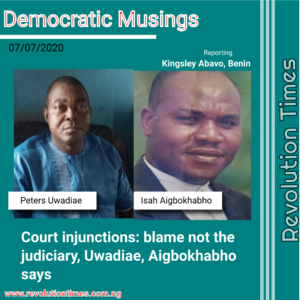
Prince Peters Uwadiae:
Let me tell you, the court cannot be a clog in the wheel of progress of Nigeria democracy. Our nascent democracy has survived up till now because the Judiciary has done its best. The politicians should be the ones to take the blame because the judges do not file cases. It is the political parties that file cases and once a case is filed in court and brought before a judge of competent power, he must certainly look at the papers before him. It is based on the papers filed that the judges will act. Assuming you approached a court for injunctive relief, from the documents you have filed, if there be satisfactory grounds to act, will the Court not grant the order? I am not sure of any that will not look at the processes filed by a party. So if critics are saying that the Courts are causing problem, it is not true as every Court looks at what comes before it.
Politicians are also becoming too desperate which pushes them into meeting judges who of course, are part of the society.
They are not extra ordinary humans and because of the prevailing circumstance some of them find themselves, coupled with the fact that they are being forced to abandon their courage or conscience to taking steps that may be inimical to the ordinary thought a man, critics find them as clog.
But this is not correct. We still have some decent judges even in the face of intense pressure or temptation to do otherwise.
Let me point out that many of our Courts have restrained from granting ex-parte applications because in this case, the Court is only looking at the papers filed by the claimant without having the opportunity of hearing from the defendant whereas some of these senior counsels will paint picture of a very gloomy situation, a state of hopelessness that the judge must intervene. When this is done, and the reason Courts exist is to ensure that law and order does not break down.
Therefore, the judge must act in line with his constitutional powers as entrenched in section 6 of the 1999 Constitution. The judicial powers are there to be exercised by the Court and they can only be exercised based on the circumstances and situation that are brought before them.
Yes, in all, the society have their blame, the politicians have their blame even as some of the judges are not courageous and incorruptible enough to withstand the pressure that comes from the political circle.
Though it must be appreciated that judges are part of the Nigerian society. They are not blind to what the politicians do; how they throw money around.
So the advice is that the politicians should not pressure the judges into acting in their favour. Also senior counsels should not paint a gloomy situation when none exist to make a judge act in a peculiar manner.
The issues are multi facetted, they should not be heaped at the door step of the judge alone.
I want to say therefore, that everyone should act his or her role in a manner that is consistent with the expectation of the people, how truly it should be.
If you are a politician, don’t be a die hard one; that you must get your way, even if you know getting your way through the wrong process is not the right thing to do.
If you are a judge and political issues come before you, look at it objectively irrespective of the fact that there are under currents coming your way because you swore to the oath of allegiance to do what is right at all times, so if you want to live by that oath, you must understand that these under currents are inimical to the oath and desist from being polluted.
Is there no mechanism, for example, office of the CJN and NJC to forcing judges to ensure they don’t grant frivolous injunctions strictly in line with their oath of office?
It’s there. Let me say this: there are some injunctive relief that are granted by some Courts. When injunctions are granted it then becomes an order in public domain particularly those of the Apex Courts, they have opportunity of looking at the injunctive relief coming from a particular judge.
There are some judges today who the NJC have punished for being notorious for granting reliefs that are pre – judicial to the society itself. So within the NJC, there are mechanism for curbing this excesses.
But be that as it may, I do also believe that judges these days have also reduced the level of granting injunctive reliefs. Those ones you see most recently were done based on the pressure mounted by the political class. Some of them were granted based on the picture painted by the senior counsels who filed these applications.
There is a level one gets to in this practice especially the SANs. If a SAN files an application seeking an injunctive order, because it is coming from a person of high repute who the Court believe will not come tell lies, and tomorrow, if the defendants come with a different picture to the same matter, the next Court sitting, you hear the same injunctive relief has been vacated by the same Court. It then means that the Court has now gotten the opportunity of hearing from the other party.
But some Court would refuse to grant an ex-parte application because it is one sided except the other party involved is put on notice to balance hearing and ruling.
My advice to the Courts which of course is the new trend now, once an ex – parte application is granted which only lasts for 14 days, the other party should also be put on notice so that the Court could have the facts of the application from both parties involved. This will enable a very objective and unbiased injunctive relief. If there is need to grant an injunctive relief, it will no longer be an ex – parte, it will be interlocutory so that it will remain in perpetuity until the case is finally disposed.
I think this a better way of dealing with the situation on ground.
Isah Aigbokhabho Esq.:
Contrary to criticism of laymen, the judiciary has not in any way acted as a clog in the wheel of progress of Nigeria democracy by reason of seemingly frequent frivolous injunctive reliefs and counter reliefs as seen in the recent past.
Rather, the truth remains that the Judges rely upon what is brought before the Court to give verdict. If a Court gives a verdict and another Court gives a contrary verdict in the same matter, yes it is not out of place.
It is the issues canvassed in Court A for example, the Judge will use in giving the verdict whereas Court B may not be aware of the issues as earlier canvassed in Court A, would instead rely on what is before it to give verdict in the same matter. The facts presented in agreement with the law; that is what the Court rely upon.
This is so because the lawyers would always present their case based on the briefing of their clients and the Court would look at the facts as they are, in agreement with the law and give judgement.
Aigbokhabho in defense of the judiciary differs with critics’ opinion that Court judgement have become ‘cash and carry’. “Although we faulted some of the rulings that a Court should not over rule a coordinate Court in a matter that is within their jurisdiction.”
But he blamed politicians for indulging in what he term; ‘abuse of Court process.’ They would file in Court A, while waiting for the verdict, they would hurriedly go to another Court of coordinate jurisdiction also to file in the same matter maybe suspecting that Court A would not give them favourable verdict. The other Court would not be aware that there is an earlier filing in Court A. In all of these, it is based on what is presented before the Court that will determine the verdict outcome.
Aigbokhabho would not also blame lawyers for the critism of failing to properly guide their clients in filing applications. He rather positioned the blame at the door mouth of litigants.
“I don’t want to blame lawyers instead the litigants because it is the brief you give to the lawyers that they present in Court.”
But he admits, that the lawyer owe the client obligation to be professionally guided in the position of his case as regards the law. However, there is no case that cannot be remedied, Aigbokhabho stated.
“Again let me point out that if a Court of coordinate jurisdiction is aware that a another Court has earlier given verdict in the same matter, and now assume jurisdiction to give a contradicting judgement, then it is tantamount to judicial rascality which should be frowned at.”