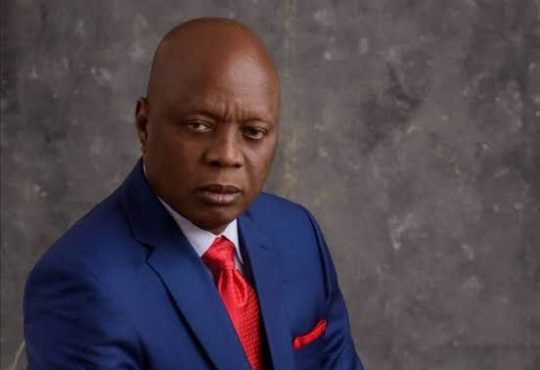


BEING A LECTURE DELIVERED BY SENATOR EHIGIE UZAMERE, KSC, ON FRIDAY, DECEMBER 19, 2025, TO THE BENIN LEADERS FORUM AT PROTEA HOTEL, BENIN CITY

PROTOCOLS
Distinguished sons and daughters of the Benin Kingdom, revered elders, honoured chiefs, esteemed guests, cherished friends, ladies, and gentlemen!
I stand before you today, humbled and profoundly grateful for the honour you have bestowed upon me in inviting me to deliver this lecture.
Your unwavering commitment to the preservation of our heritage, your relentless pursuit of excellence, and your abiding faith in the unity and destiny of our people continue to inspire generations.
I thank you sincerely for deeming me worthy of this responsibility, and I pledge to speak with humility, historical honesty, and deep love for our revered Benin Kingdom.
As the philosopher Edmund Burke once said, “A people who do not know their history are destined to repeat it.” It is therefore both timely and necessary that we interrogate our history, separate myth from truth, and free ourselves from narratives that no longer serve our collective progress.
What does UMAEGBANEDO truly mean? Is UMAEGBANEDO an immutable curse placed upon the Benin people, or is it a convenient myth repeated so often that it has become a self-fulfilling prophecy?
In common usage, UMAEGBANEDO is understood to mean that the Benin people can never agree or achieve unity of purpose.
According to oral tradition, this belief is often cited as the reason the Benins fail at collective endeavours that require cohesion, sacrifice, and shared vision.
But philosophy teaches us that “Beliefs shape actions, and actions shape destiny.” If people believe they are cursed to fail, they may unconsciously organise themselves to confirm that belief.
ORIGIN OF UMAEGBANEDO
In Benin oral tradition, Oba Ewuakpe (who reigned between 1700–1712 AD) stands as the historical figure most closely associated with what later came to be known as Umaegbanedo.
His reign was turbulent and contentious, marked by accusations of high-handedness, deep political tension, and an unprecedented revolt that united chiefs and subjects against the throne.
This rare solidarity among the people was so formidable that it temporarily isolated the Oba and forced him into exile.
Having endured humiliation, rejection, and betrayal; events that tradition links especially to circumstances surrounding his mother’s village of Ikoka, Oba Ewuakpe is said to have pronounced a far-reaching curse upon some subjects of the kingdom.
In Edo historical narratives, this pronouncement was a direct response to the unity of purpose and cooperation that had enabled his near-deposition.
According to these traditions, the Oba declared that such absolute unity would never again arise among the Benin people to threaten the monarchy.
This period of crisis and instability was eventually brought to an end through the extraordinary sacrifice of Queen Iden, the Oba’s loyal wife.
In an act remembered as one of supreme devotion, she voluntarily offered her life as sacrifice for peace, continuity, and greater good of the kingdom.
Her sacrifice was made on the condition that no man born of a woman would ever step on her grave. This is still honoured till today.
Her sacrifice is
believed to have appeased the forces unleashed during the crisis and restored order to Benin.
Notably, Oba Ewuakpe is also remembered for placing a specific curse on Ikoka, decreeing prosperity for women and poverty, and lingering developmental stagnation for the men.
Within the wider crisis of the kingdom, tradition recounts that some Iweguae palace chiefs, who are custodians of the Oba’s person and ordinarily his most loyal protectors, collaborated with certain chiefs from the outside in acts perceived as betrayal.
Deeply wounded by this breach of trust, Oba Ewuakpe is said to have declared that there would never again be unity of purpose and cooperation among the chiefs against the Oba.
Over time, this pronouncement was extended in popular memory to the broader Benin populace as a safeguard against any future collective rebellion against the throne.
Thus emerged the full expression:
“UMAEGBANEDO YA RUE OBA KHOR.” Translated, it means: the Benin people can never again come together to conspire to betray the King.
Whether understood as a literal curse or a symbolic warning embedded in history, Umaegbanedo occupies a powerful place in Benin consciousness. A reminder of the delicate balance between authority, loyalty, unity, and the consequences of betrayal.
An African proverb aptly states: “When the house is divided, the rain enters from every side,” and Edmund Burke observed that, “Those who do not know history are destined to repeat it.”
In reflecting on Umaegbanedo therefore, the deeper lesson may not lie in fear of a curse, but in wisdom drawn from history: that unity, when guided by righteousness and mutual respect, builds nations, while unity forged in anger or betrayal can shake even the most sacred thrones.
REVOCATION
In February 1937, at the historic opening of Edo College, Benin City, Oba Akenzua II of blessed memory, acting in his sacred capacity as custodian of Benin destiny, publicly revoked what had long been referred to as the curse of UMAEGBANEDO.
The Oba declared, in clear and unequivocal terms, that if indeed there existed any such curse upon the Benin people, he, as the Oba of Benin, thereby revoked it.
This pronouncement was not merely symbolic; it was a deliberate act of leadership meant to free the collective consciousness of the people from fear, fatalism, and historical burden.
As a practical follow-up to this revocation, Oba Akenzua II established Umagbae Quarter, located behind what is today known as Bight Engineering along Third East Circular Road.
In time, several communities across Benin Kingdom came to be identified as Umagbae, reinforcing the message that whatever stigma or spiritual limitation associated with the name had been permanently nullified.
This singular act of Oba Akenzua II finds apt description in these words of Hannah Arendt: “The function of leadership is to liberate the spirit of the people from fear.”
UMAEGBANEDO: FACT OR FABLE?
From the foregoing narrative, it becomes crystal clear that there was indeed a curse instituted by Oba Ewuakpe, but not upon the entire Benin people.
Historical accounts indicate that the curse was directed specifically at certain Benin chiefs, intended as a deterrent against conspiracy, betrayal, and disloyalty to the throne.
Over time, however, this narrowly targeted sanction was arbitrarily extended in popular imagination to encompass the entire Benin populace.
Recognizing the dangers of such a misconception, especially its capacity to hinder peace, progress, and development, Oba Akenzua II decisively acted.
Beyond the 1937 revocation, he reaffirmed the annulment in 1945 during the re-opening of the Holy Aruosa Cathedral, which had been destroyed in the tragic events of the British invasion of 1897.
This re-affirmation was both spiritual and political. A declaration that Benin would no longer be held hostage by the ghosts of its past.
Yet, despite these clear royal interventions, UMAEGBANEDO has lingered in the psyche of the Benin people.
Over the years, it has subtly transformed from a historical narrative into a psychological refuge for failure, often invoked to rationalize poor planning, internal rivalry, loss of influence, and declining relevance in the geopolitical equation of Edo State and Nigeria.
In the words of Epictetus, “Men are disturbed not by things, but by the views which they take of things.” But contrary to the myth of perpetual disunity, Benin history is replete with powerful moments of collective resolve:
1. Resistance to the 1897 British Punitive Expedition
When British forces invaded and sacked Benin City, the Oba’s council, warriors, guilds, and ordinary citizens stood together in defense of the kingdom.
Though ultimately outgunned, their collective decision to resist rather than surrender was a profound expression of unity in the face of existential threat.
2. Post-War Reconstruction (1900–1920)
Following the exile of Oba Ovonramwen, Benin elites, traditional institutions, and artisans collaborated to rebuild the palace, revive the bronze-casting guilds, and restore royal authority. This cooperative effort preserved Benin cultural identity under colonial domination.
3. Mid-20th-Century Political Activism
In the 1950s and 1960s, personalities such as Oba Akenzua II, Chief Humphrey Omo-Osagie, Chief Gaius Obaseki, and Bishop Noyoze Edokpolo worked in concert to advance the cause of regional autonomy. Their alliance demonstrated how traditional authority and modern politics could be harmonized in pursuit of a shared goal.
4. Cultural Revival (1970s to the Present)
The establishment of the Benin Cultural Center and the revitalization of the Igue Festival brought together the palace, artists, scholars, and communities. This sustained cooperation continues to project Benin heritage onto the global stage.
INSTANCES OF DISUNITY AND THE MODERN UMAEGBANEDO
The modern manifestation of UMAEGBANEDO, not as a curse but as a mindset affliction, became pronounced after the 1966 military coup, which ushered in centralized military rule. Political power, influence, and patronage became concentrated centrally at the federal level. Consequently, relevance depended on proximity to central authority.
Outside General Osaigbovo Ogbemudia of blessed memory, whose close relationship with General Yakubu Gowon placed Benin momentarily at the center of national influence, no Benin sons, military or civilian, have enjoyed sustained access to the president. In the Second, Third, and Fourth Republics, the Benins largely became pawns in Edo State and national political chessboards.
In the struggle for scarce opportunities, internal betrayal replaced collective advancement.
Like crabs in a basket, some Benins often undermine fellow Benins while seeking personal validation and patronage from power blocs in Edo Central and Edo North.
It is within this environment of fragmentation, not spirituality, that UMAEGBANEDO appears to “work.” We unfortunately indulge in this selfish pursuit unmindful of the fact that, “No enemy can defeat people who refuse to defeat themselves,” as noted by Kwame Nkrumah.
THE WAY FORWARD
Let me once again re-emphasize a fundamental historical truth: Oba Ewuakpe did not curse the Benin people.
The sanctions attributed to his reign were directed specifically at erring chiefs, imposed solely to safeguard the sanctity, continuity, and stability of the monarchy.
Over time, however, this specific historical action was arbitrarily and unfairly generalized, becoming ascribed to the Benins as a whole.
In the present dispensation, therefore, our greatest task is not ritualistic but intellectual and psychological.
We must consciously reset our collective mindset and deliberately erase any perceived affliction that has taken root in our mentality.
As the philosopher Epictetus wisely noted, “Men are not disturbed by things, but by the views they take of them.” If Umaegbanedo exists today, it exists more in perception than in reality.
What is required of us now is bridge-building across districts, across ethnic lines, and across geopolitical zones. No people prosper in isolation.
In a modern, interconnected Nigeria, the Benin man and woman must penetrate broader political, economic, and intellectual networks to secure opportunities for our people and accelerate the development of our homeland.
We must let go of the burdens of the past and embrace the responsibilities of the present.
The glorious history we so proudly celebrate was not handed down by chance. It was built through hard work, discipline, foresight, and sacrifice by our forebears.
If we truly honour them, we must be willing to subordinate narrow personal interests to the collective good of the Benin nation, just as Queen Iden N’Okpokhuo exemplified courage, sacrifice, and selflessness in defense of our heritage.
As Edmund Burke further reminds us, “A society is a partnership not only of the living, but of the dead and the unborn.” Our actions today must therefore be guided by the future we desire for generations yet unborn.
CONCLUSION
In contemporary times, UMAEGBANEDO is no longer a curse of the past; it is a mindset that must be deleted from our collective psyche.
The real battle before us is mental, strategic, and developmental. We must consciously and intelligently navigate Nigeria’s complex political terrain with clarity of purpose and unity of vision.
Our pathway forward lies in human capital development, deliberate bridge-building, and strategic engagement with fertile spaces that can enhance our growth in an increasingly dynamic and competitive world.
We must transition decisively from greed, hatred, envy, and jealousy, which unfortunately can only culminate in Umaegbanedo and gravitate towards unity, love, cooperation, and shared prosperity which will surely lead us to UMAGHAGBANEDO.
Once again, I express my profound appreciation to the organizers of today’s event for their sacrifice and financial commitment to this noble project and to the distinguished audience for your patience and attentive listening.
As we approach the Christmas season and the New Year, may we also remember that leadership is best expressed through compassion.
Kindly share from what you have with those who do not have, especially members of your extended families and your neighbours. In giving, we strengthen the bonds that hold us together.
I wish you all a Merry Christmas and a prosperous New Year.
Iselogbe!
Source: Osaze Edigin Facebook page