


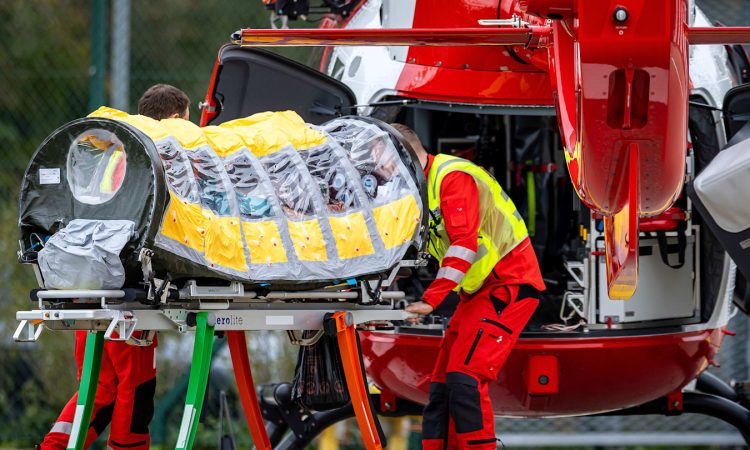
 Photo: A patient is transferred in a sealed isolation unit from a rescue aircraft to a helicopter at Zurich Airport © Michael Buholzer/EPA/Shutterstock
• To continue monitoring of 52 other contacts
• As more than 9,700 confirmed cases, 4,680 deaths recorded in DR Congo, Uganda – WHO
From our news desk, Lagos

In a concerted efforts of the Nigeria authorities to contain the spread of the dreaded ebola disease, the infected woman who entered the country from Uganda was on Monday, 26 October, 2026 evacuated to Switzerland, reports say.
The woman identified as a 42-year-old wife of an Abuja-based Swiss diplomat, was said to had been travelling in Uganda before returning to Nigeria early this month.
Nigeria authorities on red alert, acting swiftly, confirmed the woman was diagnosed as its first case of the deadly Bundibugyo virus, which health authorities reportedly said has no vaccine, on October 20.
According to the Financial Times report, Nigeria was the fourth African country to be affected since the virus was first discovered spreading in the north-eastern Democratic Republic of Congo in mid-May.
The evacuation of the woman and her husband was confirmed by the Nigerian health minister Muhammad Pate, who added that her condition had stabilised, the report says.
“The index patient was clinically much improved, stable, conscious, communicating, and her clinical laboratory test results closing towards baseline,” Pate wrote.
Also, Mohamed Janabi, the regional director for Africa at the World Health Organization (WHO) was quoted to have said the couple were both Swiss citizens.
He added; that Nigeria would continue the monitoring of 52 other people, which include healthcare workers and domestic staff, identified as having had close contact with the woman.
The report further states that the Swiss authorities in a statement disclosed that the woman had been transferred to Geneva University Hospital, and her husband put in isolation at the Zurich University Hospital.
However, there was no risk to the Swiss population, the statement was quoted to have asserted.

But the WHO said as of last week there had been more than 9,700 confirmed cases and more than 4,680 deaths in the outbreak, almost all in DR Congo and Uganda.
Kenya had its first imported case in early October and has since confirmed eight further transmissions.
Quoting Damien Tully, an associate professor at the London School of Hygiene & Tropical Medicine, the report says the risk of further spread across Nigeria would depend on the nature of the Swiss patient’s contact with others.
“Ebola is not generally transmitted before symptoms develop, so simply counting the number of contacts does not tell us how many people were genuinely at risk,” he said.
There is concern about the delay in identifying and diagnosing the Ugandan-born woman, who had travelled through Entebbe in Uganda and Addis Ababa on her way home to Nigeria.
The woman, who had not travelled to DR Congo, did not start showing symptoms until October 7 and only sought clinical assistance four days later. It was a further nine days before she was diagnosed.
Emma Thomson, director of the MRC-University of Glasgow Centre for Virus Research, said Bundibugyo could be “difficult to recognise clinically” and added that symptoms resembled those of other illnesses, including malaria.
She said the delay created opportunities for onward transmission.

Continuing, the Financial Times said Nigeria was praised for moving quickly to stop the spread of Ebola during a previous outbreak in west Africa in 2014 that killed more than 11,000 people.
It is set to host a delegation of visiting scientists to investigate the transmission chain.
Though Uganda was said to have insisted that it has had no new Ebola cases since July; and was declared Ebola-free by the WHO in August.
The country in efforts to contain the spread of the virus, has banned non-essential travel to and from neighbouring DR Congo and says that returning Ugandans will need to quarantine for three weeks, it was said.
But experts have pointed out that the porousness of borders between the DR Congo and Uganda made it hard to control the spread of the virus.
Tully, who also works with the Medical Research Council/Uganda Virus Research Institute, said Uganda faced a continued risk of cross-border infections from neighbouring DR Congo and that there had been “legitimate concerns” about surveillance across the wider outbreak.
“We should be cautious about assuming that the absence of reported cases necessarily means the absence of transmission.
“Surveillance systems are never perfect, particularly when early symptoms are non-specific and infected individuals may not seek healthcare immediately.”
Source: Finance Times


