


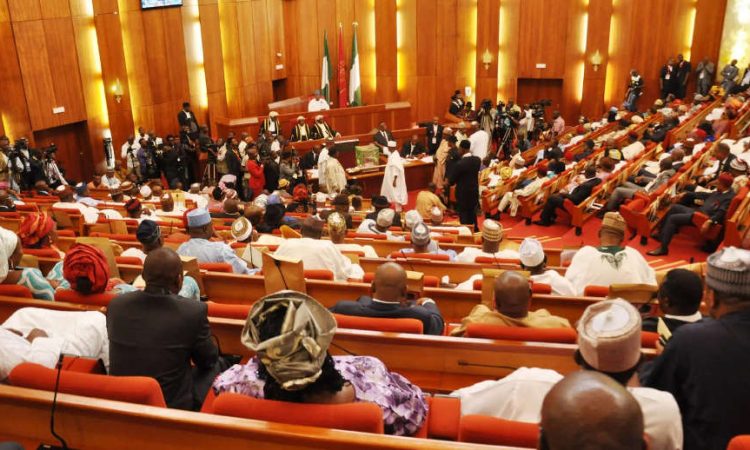
 Nigeria Senate in session on Tuesday, 10 February, 2026 in Abuja Federal Capital Territory
 Nigeria Senate President, Godswill Akpabio
• Also manual Form EC8A as alternative in case…
From our Correspondent, Abuja
The Nigeria upper chamber of the National Assembly, (Senate) on Tuesday, February 10, 2026 reversed itself on the contentious direct Electronic Transmission of Election Results, by voting in support.
The Senate seemingly in reaction to the outpour of condemnation by the Nigeria public of its hitherto rejection of the amendment, passed the bill allowing the electronic transmission of election results directly from the polling units; but provided safeguards to address potential technical challenges.
The Lawmakers on Wednesday, 4 February, 2026 had rejected the compulsory electronic transmission of results from polling units to the Independent National Electoral Commission’s (INEC) Result Viewing Portal (IREV).
This attracted wide spread condemnation from the Nigerian public including protest by organized civil societies in Abuja.
Passing the bill, the Senate however spelt out that where internet connectivity fails, the alternative Form EC8A will remain the primary instrument for result collation, while the electronic transmission would serve as the primary method of uploading results.
As usual, the Form EC8A, must be duly signed and stamped by the presiding officer.
12-member committee
After passing the bill, the Senate constituted a 12-member conference committee to harmonise the differences between its version of the Electoral Act (Amendment) Bill and that of the House of Representatives.
“After consultation with the leadership, we have moved the number from nine to 12. I will now read out the names of the conference committee members from the Senate,” Akpabio said on the floor of the Senate.
The members:
1. Senator Simon Bako Lalong – Chairman
2. Senator Mohammed Tahir Monguno – Member
3. Senator Adamu Aliero – Member
4. Senator Orji Uzor Kalu – Member
5. Senator Abba Moro – Member
6. Senator Asuquo Ekpenyong – Member
7. Senator Aminu Iya Abbas – Member
8. Senator Tokunbo Abiru – Member
9. Senator Niyi Adegbonmire (SAN) – Member
10. Senator Jibrin Isah – Member
11. Senator Ipalibo Banigo – Member
12. Senator Onyekachi Nwebonyi – Member
The Senate President, Godswill Akpabio urged the committee to handle its assignment with all sense of urgency, hoping for a swift conclusion of the process.
All things being equal, the outcome could be transmitted
to the President, Bola Tinubu for assent in February, Akpabio said.
Controversial clause
The Senate had suffered an overwhelming backlash from the majority of Nigerians for voting against the E-transmission of election results.
Underlining the condemnation; is Clause 60(3), which the Senate amended last week by removing the requirement for real-time electronic transmission.
Instead, lawmakers retained the 2022 Electoral Act provision granting the Independent National Electoral Commission (INEC) the discretion to determine how election results are transmitted.

 Coalition of CSOs in ‘The Occupy National Assembly demonstration in Abuja on Tuesday, 10 February, 2026
The Occupy National Assembly demonstration in Abuja, Civil society groups, opposition parties, and high-profile political figures such as Peter Obi and Rotimi Amaechi joined the calls for mandatory real-time electronic transmission, arguing that it is essential to improving the transparency and credibility of elections.
 Godswill Akpabio
Akpabio addresses criticisms
Responding to criticisms over the Senate’s decision on electronic transmission of results, Mr Akpabio insisted that the amendment did not abolish electronic transmission.
“Distinguished colleagues, the social media is already awash with reports that the Senate has literally rejected electronic transmission of results. That is not true. What we did was to retain the electronic transmission, which has been in the Act and was used in 2022.
“So please, do not allow people to confuse you. If you are in doubt, we will make our final votes and proceedings available to you if you apply.
“This Senate under my watch has not rejected the electronic transmission of results. It is in my interest as a participant in the next election for such to be done. So please don’t go with the crowd.
“We have retained what was in the previous provision by way of amendment. That was all we did. The previous has made allowance for electronic transmission. So it is still there as part of our law. We cannot afford to go backwards,” Akpabio said.
The upper chamber passed the Electoral Act Amendment Bill a few hours after the Independent National Electoral Commission (INEC) urged it to pass the bill.
At a meeting with the Civil Society Organisations (CSOs) in Abuja, the commission’s Chairman, Joash Amupitan, asked the Senate to expedite action on the bill to avoid negatively impacting its plan and preparations for the 2027 polls.
The House of Representatives has since passed the bill and transmitted it to the Senate for concurrence.
Additional report by Premium Times